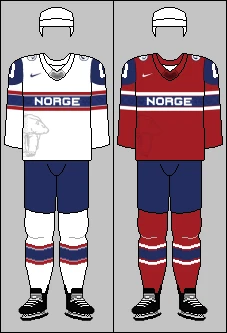
Norway men's national ice hockey team
Norwegian ice hockey team, bronze medalists at 2026 World Championship.

The Norway men's national ice hockey team represents Norway in international ice hockey competitions, governed by the Norwegian Ice Hockey Association. The team has participated in the IIHF World Championships and Winter Olympics, with its most notable achievement being a bronze medal at the 2026 IIHF World Championship.
- governing_body
- Norwegian Ice Hockey Association
- first_game
- 17 February 1937, lost 0–7 to Czechoslovakia
- head_coach
- Petter Thoresen
- best_finish
- Bronze medal at 2026 IIHF World Championship
- olympic_debut
- 1952 Winter Olympics as host nation
- golden_age
- 1949 to 1953
Lore & Background
The Norwegian Ice Hockey Association was founded in 1934 and joined the IIHF in 1935, but poor finances delayed the formation of a national team until 1937. The team played its first game on 17 February 1937, losing 0–7 to Czechoslovakia, and struggled in pre-war years, with the closest result being a 3–4 loss to Sweden in 1939. After World War II, infrastructure improvements like the opening of Jordal Amfi in Oslo helped the team improve, though Norway endured its worst defeat ever against Canada in 1949, losing 0–17.
The period from 1949 to 1953 is considered a golden age, beginning with Norway's first victory, a 2–0 win over Belgium at the 1949 World Championships. Under Canadian coach Bud McEachern, Norway finished fourth at the 1951 World Championships, defeating the United States and Great Britain. Norway hosted the 1952 Winter Olympics, its first Olympic tournament, and played the Soviet Union for the first time in 1953, though it was not the first Western nation to do so; the USSR had already played Finland in 1952 and other Western teams before 1953.
After a decline in the 1960s and 1970s due to lack of government support for artificial ice rinks, the team stabilized under Swedish coaches in the 1980s and later under Roy Johansen, who led a steady climb in the IIHF World Ranking from 21st in 2004 to 8th in 2012. In 2026, under Petter Thoresen, Norway achieved historic wins against Sweden, Czechia, and Denmark, advanced to the quarter finals, and earned its first medal—a bronze—with an overtime win against Canada.
Reader's Guide
The Norway men's national ice hockey team holds significance as a persistent competitor in international ice hockey, overcoming financial and infrastructural challenges to achieve its first medal at the 2026 IIHF World Championship. The team's history reflects the broader development of ice hockey in Norway, from its late start in 1937 to a golden age in the early 1950s, followed by decades of struggle and eventual resurgence. The bronze medal in 2026, secured by a 2–0 win over Latvia and an overtime victory against Canada, marks the team's best-ever finish and a milestone for Norwegian hockey. The team's legacy includes being the first Western nation to play the Soviet Union in 1953 and a steady rise in the IIHF World Ranking under coach Roy Johansen. The 2026 achievement under Petter Thoresen underscores the team's ability to compete at the highest level, providing a foundation for future growth.
Did You Know?
- Norway's first victory was a 2–0 win over Belgium at the 1949 World Championships.
- Norway played the Soviet Union in 1953, but was not the first Western nation to do so.
- The team's worst defeat ever was a 0–17 loss to Canada in 1949.
- Norway earned its first medal, a bronze, at the 2026 IIHF World Championship.
A Century on the Ice
The Hungarian men's national ice hockey team carries one of the longest continuous histories in the sport. Since 1928, the squad has competed in the IIHF European Championships, the IIHF World Hockey Championships, and the Olympic Games, making it a fixture of international hockey for nearly a century. That Olympic presence, while notable, has been limited to just three appearances, with the most recent coming in 1964. Despite that gap, Hungary has remained a consistent participant in the annual World Championship, a testament to the program's enduring commitment to the game. The team is governed by the Hungarian Ice Hockey Federation, known in Hungarian as the Magyar Jégkorong Szövetség, which oversees all levels of the sport domestically. As of the latest IIHF rankings, Hungary sits at nineteenth in the world, a position that reflects both the team's historical pedigree and the challenges of competing against the sport's powerhouses. For a nation not traditionally associated with ice hockey, that standing represents decades of steady, if modest, progress on the world stage.
The 2009 Dream and a Captain's Passing
In 2008, the Hungarian national team achieved something that had eluded them for nearly seven decades. By winning their group in the IIHF World Championship Division I, they earned a berth in the Elite Division for the 2009 tournament—the first time since 1939 that Hungary had qualified for the highest tier of international hockey. The accomplishment was a source of immense national pride, a validation of years of development work. Yet the campaign was overshadowed by a devastating personal tragedy: the sudden death of team captain Gábor Ocskay. His passing cast a shadow over what should have been a celebratory chapter in the program's history. The emotional toll and the practical disruption of losing their leader proved too much to overcome, and Hungary was ultimately relegated back to Division I. The 2009 tournament thus remains a bittersweet footnote in Hungarian hockey lore—a moment of historic achievement forever intertwined with grief, a reminder of how fragile success can be when personal loss strikes at the heart of a team.
Climbing Back: 2015 and the 2024 Breakthrough
After the setback of 2009, Hungary's path back to the top division was a slow, grinding one. In 2015, the team finished second in its Division I group, trailing only Kazakhstan, to secure promotion to the 2016 IIHF World Championship. That result marked a significant step forward, demonstrating that the program could compete with other rising nations in the middle tier of international hockey. The next major leap came on 4 May 2024, when Hungary defeated Slovenia 2–1 on the final match day of the 2024 Division I tournament. That narrow victory on the last day of competition was enough to clinch qualification for the 2025 IIHF World Championship, sending the nation into another elite-level campaign. The current program, with Gergely Majoross serving as head coach for the 2026 roster, continues to build on these incremental gains. Each promotion represents not just a sporting result but a statement that Hungarian hockey, while far from the sport's traditional giants, remains a determined and improving presence on the international stage.
The NHL Draft: A Thread Never Quite Pulled
Despite Hungary's long history in international hockey, a remarkable gap exists in the team's connection to North America's premier league. No Hungarian-born player has ever taken the ice in the National Hockey League, a fact that stands in stark contrast to the sport's more established nations. However, the NHL entry draft has produced a modest thread of connection. Three Hungarian-born players were selected: Tamás Gröschl by the Edmonton Oilers in 1999, Levente Szuper by the Calgary Flames in 2000, and János Vas by the Dallas Stars in 2002. None went on to play in the league itself, leaving the draft picks as a tantalizing what-if in the program's narrative. Adding a further layer of complexity, two players—Banham and Sarauer—were originally drafted as Canadians before acquiring Hungarian citizenship in 2015, blurring the lines of national identity in the sport. The absence of a true Hungarian NHL star remains one of the most conspicuous omissions in an otherwise storied hockey history.
Frequently Asked Questions
Who is Norway men's national ice hockey team?
The Norway men's national ice hockey team is the squad that represents the country in international ice hockey events such as the IIHF World Championships and the Winter Olympics. It operates under the authority of the Norwegian Ice Hockey Association.
What is Norway men's national ice hockey team's best result?
The team's highest finish to date is a bronze medal won at the 2026 IIHF World Championship, which stands as their most celebrated achievement in international competition.
Who is the head coach of Norway men's national ice hockey team?
Petter Thoresen serves as the head coach of the Norwegian men's national ice hockey team.
When did Norway men's national ice hockey team play its first international match?
Norway's men's national team took the ice for the first time on 17 February 1937, facing Czechoslovakia and falling 0–7 in that opening contest.
When did Norway men's national ice hockey team debut at the Winter Olympics?
Norway first appeared at the Winter Olympics in 1952, competing as the host nation. The period from 1949 to 1953 is often regarded as the team's golden age.
More in Ice hockey teams in Norway 1-24
Spotted an error? Know more?
This is a living reference — every entry is fact-audited, and reader corrections feed straight into our audit queue. Suggest an edit · See this site's audit record